
Science · 6 min read · 14 November 2026
Presbyopia field study: preliminary results from 20 participants.
Following our earlier laboratory validation and Android pilot, we tested Glassless with an additional 20 presbyopic participants using a fixed, orthoptist-led field protocol. These preliminary results explore whether correcting smartphone content can improve perceived readability beyond the laboratory.
- Presbyopic participants
- 20
- Image evaluations
- 80
- Rated better or significantly better
- 56%
- Rated significantly better
- 37%
Percentages refer to the 80 image evaluations, not the proportion of participants who benefited. The 37% rated significantly better is included within the 56% rated better or higher.
01 · Study design
Isolating presbyopia in the field.
The purpose was to measure changes in the readability of smartphone content at near distance. A qualified orthoptist screened participants and guided each session using a dedicated web application.
Eligible participants were aged 40 or older, reported reading difficulty and presented only lower-order aberrations: myopia, hyperopia or astigmatism. Higher-order aberrations and ocular conditions such as cataract or retinopathy were exclusion criteria.
Before testing, any lower-order aberrations were corrected with trial lenses to isolate the remaining near-vision deficit due to presbyopia. The application stored anonymous records of refraction values, selected correction strengths and scores; the protocol specifies that no personally identifiable data is collected.
02 · Protocol
Four images. One consistent procedure.
The smartphone was held at 20 cm. For each image, participants first viewed the content without Glassless correction, then adjusted correction strength to find their best readability. They rated improvement relative to the uncorrected view.
- “SEDF 4XAV8 3E76” in 2 mm-tall black characters on a white background.
- The same letters and numbers in 1.5 mm-tall characters.
- The Italian sentence “Togli gli occhiali, leggi con Glassless” in 1.5 mm-tall characters.
- A home icon, representing a familiar user-interface element.
| Score | Meaning |
|---|---|
| 0 | No improvement |
| 1 | Slightly better |
| 2 | Better |
| 3 | Significantly better |
03 · Preliminary results
Participants reported improved readability.
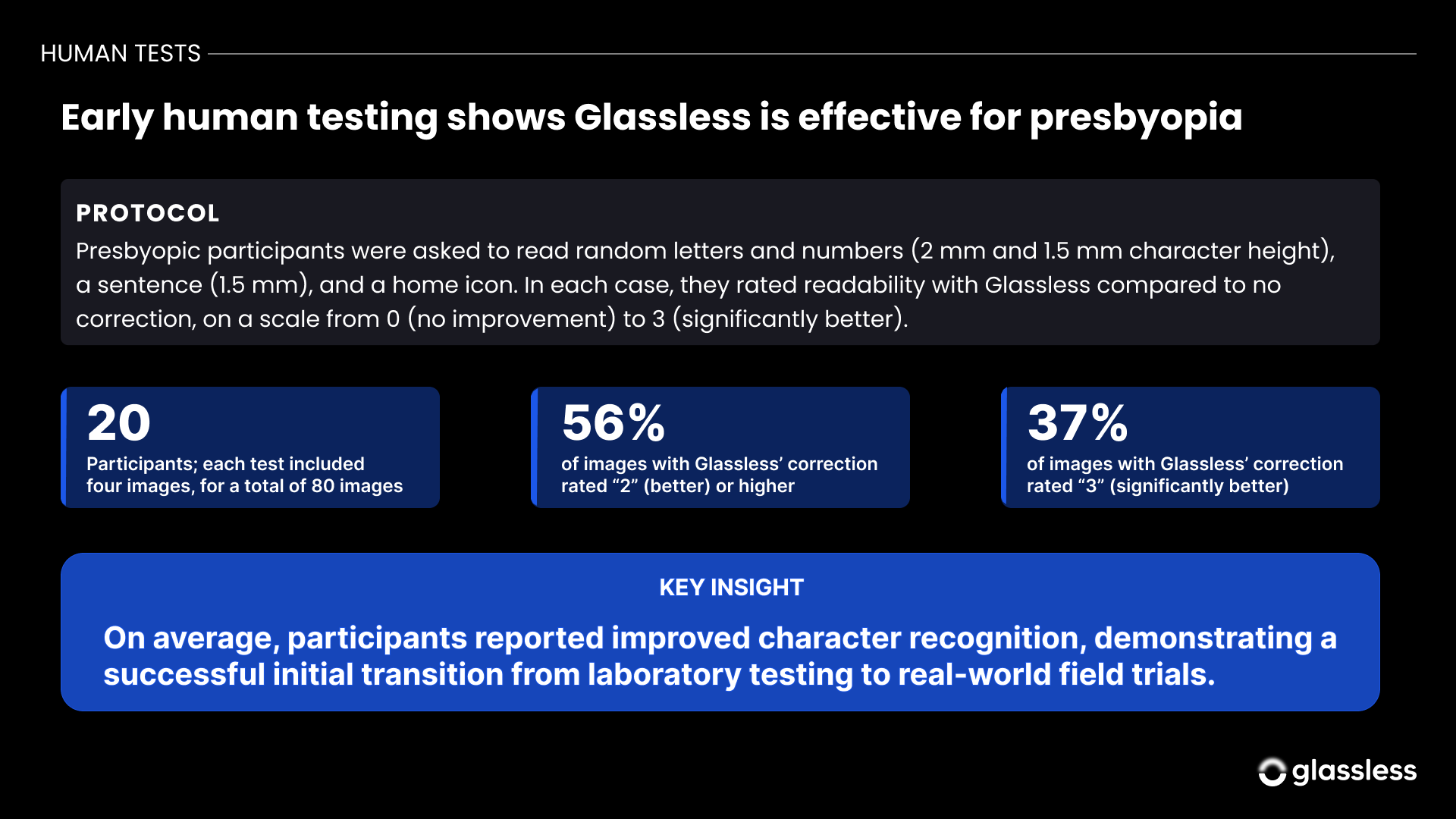
Twenty participants evaluated four images each, producing 80 image evaluations. Overall, 56% of images with Glassless correction were rated 2 (“better”) or higher; 37% were rated 3 (“significantly better”).
On average, participants reported improved character recognition, marking an encouraging initial transition from laboratory testing to real-world field trials. The reported percentages measure subjective readability improvement, rather than an objective character-recognition accuracy score.
04 · Interpretation and next steps
An encouraging signal, not a final conclusion.
This small field study adds to the earlier preliminary work covered in our first research article: an induced-defocus study with 21 participants and an Android pilot with 10 presbyopic readers. The new protocol uses a fixed sequence, defined eligibility criteria and a consistent improvement scale.
The protocol is designed to expand to additional content, including RGB images, and newer Glassless models. Further analysis can examine score distributions, preferred correction strengths and relationships with baseline refraction.